
Australian children spent more than two hours a day on TikTok in 2025 prior to ban: Qustodio report
Australian kids spent more time on Roblox for mobile than any other nation studied, averaging 87 minutes per day, while on desktop the average time spent was 133 minutes
Children's use of ChatGPT app has increased by 417 per cent since 2024
Sydney, Australia – Before the implementation of the social media ban, Australian children spent more time on TikTok than ever before, according to a new report from world-leading online safety company Qustodio.
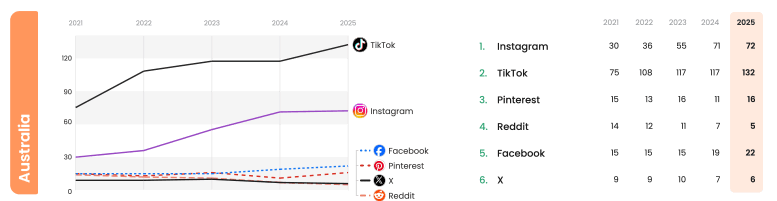
In 2025 Australian children spent an average of 132 minutes per day on TikTok, spending more time on the social media app than children in the US, UK, Brazil, France and Spain. Time spent on the app had steadily increased year-on-year, from an average of 75 minutes per day in 2021.
The second most popular social media app was Instagram, with Australian children using the app for an average of 72 minutes per day.
The annual report, titled “Lost in the Scroll”, is based on anonymous app and online tools usage on device data collected from over 400,000 family homes in six major world markets: the US, Brazil, UK, France, Spain, and Australia, along with 10,000 schools in the US, UK, and Australia. In addition to revealing the apps most favoured by children between the ages 4-18, and the screen time spent on them, the report includes insights from over 1,300 parents who shared the challenges they faced during a transformative year defined by growing resistance to children's use of devices and social media.
“We’re more than a month into the social media ban era, and we’re already seeing a ‘how to’ culture emerging online to discuss methods to skirt the ban. Many under-16 year olds are sharing tips and tricks on the very apps they should be banned from,” said Yasmin London, global online safety expert for Qoria, the parent company of Qustodio.
When it comes to social communication apps, the most popular is Snapchat, with an average time spent on the app of 63 minutes per day. Discord, not included in the ban, is the second most popular, with an average of 24 minutes per day.
“With the ban in place – and assuming they haven’t sidestepped the ban in some way – we expect kids who were raised in an online era to migrate to gaming or messenger platforms, such as Discord, Steam and Steam chat, WhatsApp and more” said London. “And Australian kids are already leading the world with how much time they spend on their mobile devices playing Roblox.
“As the list of banned platforms remains fluid, other apps and platforms could find themselves banned in the future. As such it’s vital that parents understand the new platforms kids will engage with in the absence of social media come with their own risks.”
Children spending average of over two hours a day on Roblox desktop
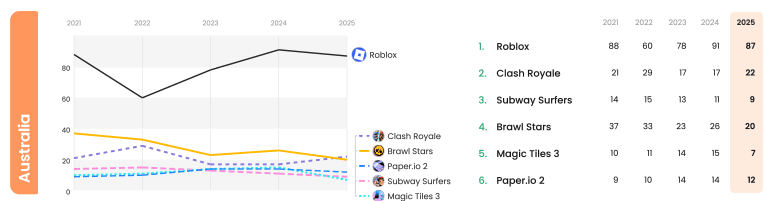
Australian children are spending more time on the Roblox mobile app than any other country studied. The average time spent on Roblox for mobile is 87 minutes per day, well above the global average of 76 minutes, and on desktop the average time spent on the platform skyrockets to 133 minutes. Roblox is a platform that allows users to create, share and play games created by other users. While it can be a great way for kids to connect, it doesn’t come without risks. User-generated content, in particular, can expose young kids to inappropriate themes.
“When children have mobile phones, parents often make a conscious decision to restrict access to certain apps, or put time limits in place. Yet shared devices, like the family computer or smart television, often slip under the radar,” said London.
“While Roblox does have its own restrictions on chat functions for kids’ accounts, many experts have raised concerns that they don’t work and kids can easily skirt them. Having not been included in the government social media ban, it makes use of these online games – and their chat rooms – easy, accessible and, crucially, unmonitored. It will be interesting to see whether the average time spent on Roblox increases in 2026.”
Reflecting the 2024 results, in 2025 the three most blocked gaming platforms for desktop were Roblox, Minecraft and Fortnite. Other popular gaming platforms include Clash Royale, Brawl Stars and Rocket League, among others.
“Children can learn some great skills from gaming, such as problem solving, and as a creative outlet. However, parents need to be aware of the risks that come with online gaming, especially those with a chat function,” said London.
“There have been reports of adults using Roblox and other gaming apps to engage with children for nefarious means, such as recruiting, bullying, harassment or grooming. And while those interactions are still limited, they do occur, and parents need to be mindful their kids may be exposed to these risks.”
AI: the new “social” dilemma
Artificial intelligence tools are still relatively new, yet the way children are interacting with AI platforms and companion bots has already shifted. In 2025, 46 per cent of kids visited chatgpt.com, compared to 24 per cent of children in 2024.
When it comes to use of the ChatGPT app, in 2025, 23 per cent of Australian children used the app for an average of 11 minutes per day, up from four percent using it for seven minutes in 2024.
Many parents assert children are using AI tools to help with homework, to get advice, as a classroom tool, to create videos or images, or to converse with it. Using AI to “chat” can cover a broad range of interactions, from casual conversation to recent reports showing children are using chatbots for mental health support.
Companions and chatbot app use remains more niche, but those who are using the apps are using it for an average of 45 minutes per day. The most popular companion bot is Polybuzz with 1.9 per cent of Australian children using the app, the average time spent on the app is 47 minutes per day. The chatbot described itself as a “free, private, unrestricted AI chat”.
Character AI is the second most popular with 1.3 per cent visiting the app, for an average of 52 minutes per day. Character Ai, owned by Google, is a generative AI chatbot service where users can engage in conversation with customisable characters.
Talkie AI is the third most popular with 0.7 per cent of children visiting the chatbot. Despite its lower popularity, time spent on the chatbot was the highest, with an average of 60 minutes per day. Talkie AI describes itself as a way to create personalised connections, have conversations that feel real and a way to discover AI friends.
Notably, this data is only drawn from applications children have downloaded on personal devices; it does not include AI applications or chatbots that can be accessed through other means, such as Meta AI and web browsing.
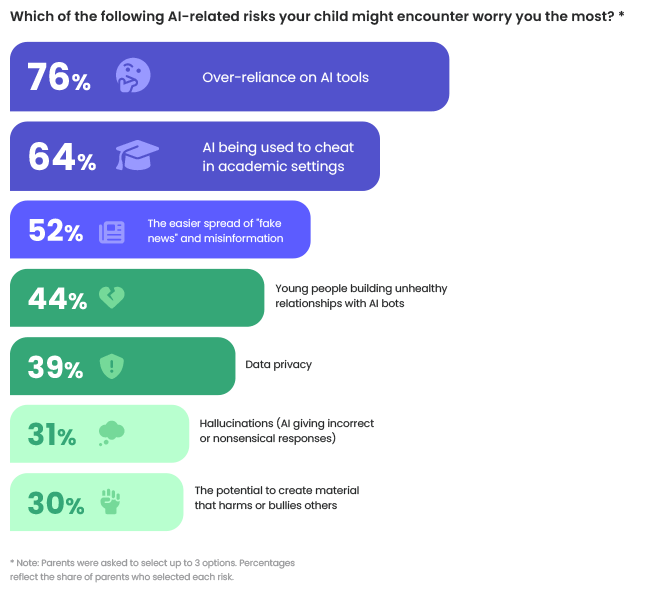
While AI will inevitably become a core part of work and life, parents are understandably concerned about the way children are using the AI platforms. Concerns include an over-reliance on AI tools, using it to cheat, the spread of fake news and building unhealthy relationships with AI tools.
“While every child is different, parents and adults need to pay attention to potential red flags around AI chatbot use,” said London. “There are some behavioural changes that could indicate an over-reliance on the technology, including if the time spent interacting with chatbots or AI tools is increasing, or the user is prioritising it over time with friends or family, if a child is being secretive about the use of AI, relying on bots for emotional support, if a sudden change in mood occurs or they begin talking about bots as if they’re real people.
“If you notice these changes, it's important to start the conversation with the person from a place of curiosity rather than being accusatory. Ask which AI tools are being used and what they like about them. Create a conversation where you explore the positives and negatives together. This way, the user is more likely to open up to you, and you can create a plan together.”
Methodology
Since 2019, our research has investigated and documented children’s digital habits in in order to better understand their online experience. Lost in the scroll explores young people’s online app habits on mobile, desktop, and school devices, from January 1, 2025, to December 31, 2025, compared with information from the same period between 2021 and 2024.
About Qustodio
Qustodio is the world leader in online safety and digital wellbeing for families. Since 2012, we have provided a cross platform solution for families and schools, helping over 9 million families protect children from harm, while promoting healthy digital habits and awareness. Available in over 180 countries in 8 languages, our digital wellbeing tools help families and schools live and navigate smarter in an increasingly connected world. In 2022, Qustodio became part of the Qoria group, protecting every child’s digital journey through a world-class collaboration between schools, parents, and educators in cyber safety.